
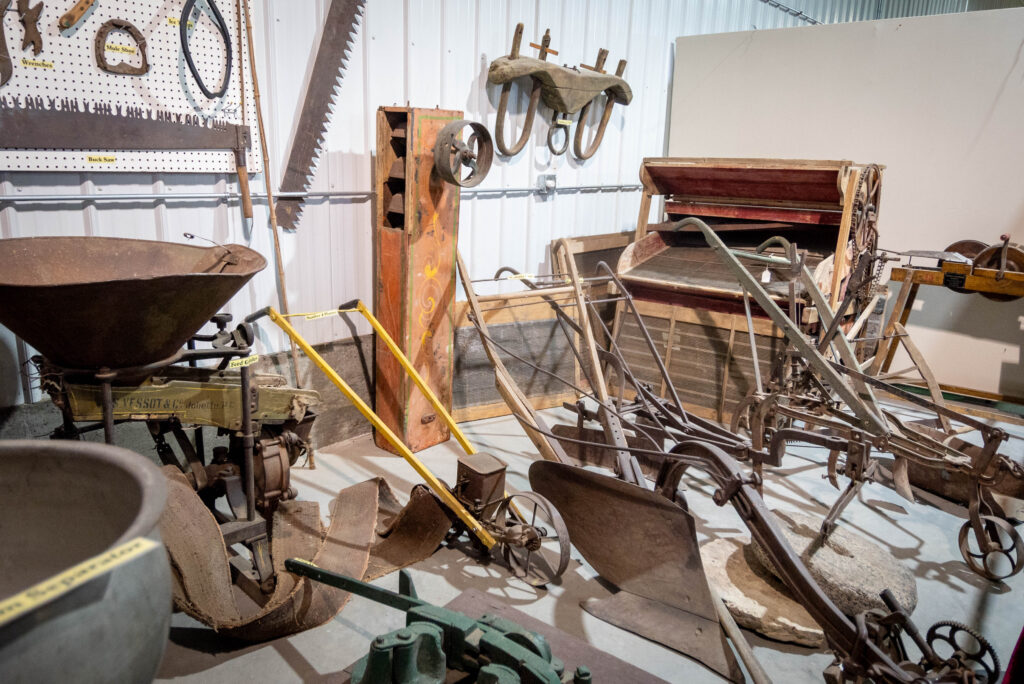
This stable shows different machines used by early settlers to help ease their work around the farm. Very different compared to what farmers use today like combines and big tractors.
Farmers would use almost all of this equipment whether it was for their animals or for their fields. Horses pulled the larger machines around which saved the farmers lots of time and hard work. However, not every farm owned a horse. Anyone could go and rent a horse from a livery.

Rope Maker
The Rope Maker Machine was produced in the early 20th century. Tthis hand-crank tool was used to twist and wind rope for agricultural and industrial applications.

Everyday Tools
These antique farming tools were used for everyday farm and ranch work, including raking hay, cutting grass and crops, digging, fencing, shoeing horses, and harvesting. The collection includes hand rakes, grass hooks, sickles, saws, fencing tools, horse shoes, and blacksmith/forge tools, representing the manual labor and craftsmanship common on farms before modern machinery.


Feed Grinders
These feed grinders were used on farms to process grain such as corn into meal for livestock. The one on the right was horse-, mule-, or ox-powered, while the left International Harvester grinder used a hand crank; both provided farmers with an efficient way to prepare animal feed before modern motorized equipment. These feed grinders were commonly used from the late 1800s through the early-to-mid 20th century, with the International Harvester model particularly associated with the early 1900s–1930s.

Root Cutter
This antique root cutter was a hand-operated farm machine used to chop root crops such as turnips, beets, and potatoes into smaller pieces, often for livestock feed. The large rotating cutting wheel was turned by the hand crank, while the hopper held the roots and guided them toward the blades for cutting.
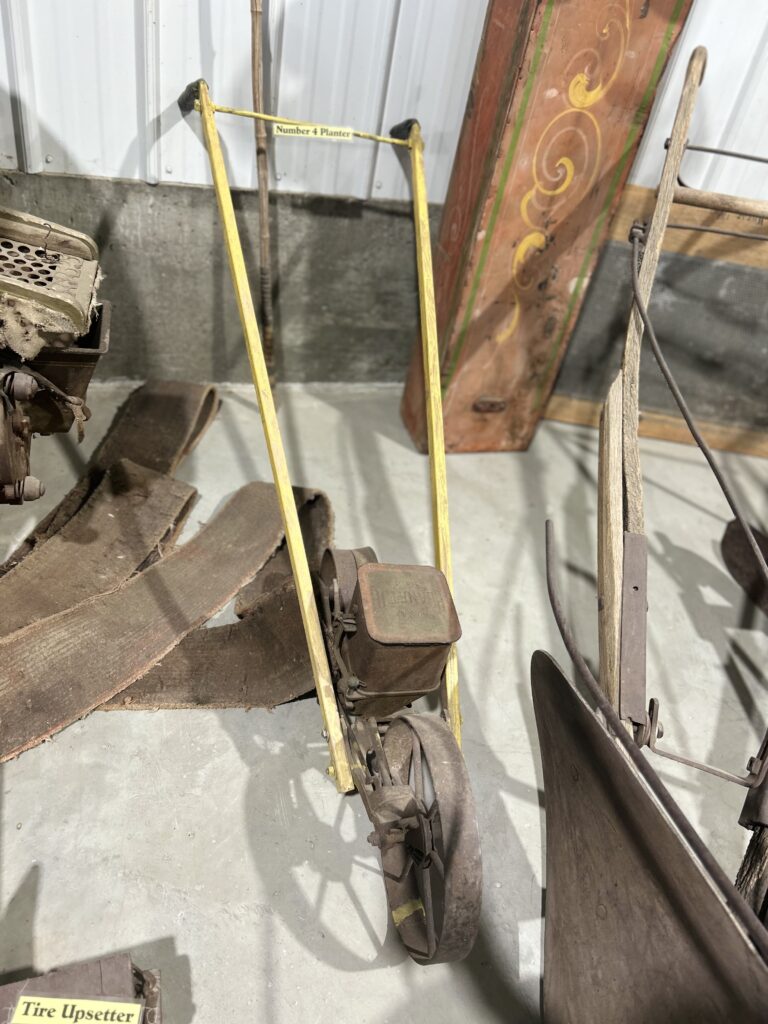
Number 4 Planter
The machine is a Planet Jr. No. 4 Combined Seeder and Cultivator, introduced in 1897 and manufactured into the 1950s. It was pushed by hand, with the wheel powering the seed mechanism, which could plant seeds continuously in rows or drop them at set intervals while opening, covering, and firming the soil.

Wheat Tester
Hand crank wheat tester with a wooden frame, a large hand wheel, and a chain mechanism for operating the device. Such testers were used in the 19th and early 20th centuries to measure the moisture content of wheat kernels for quality control.
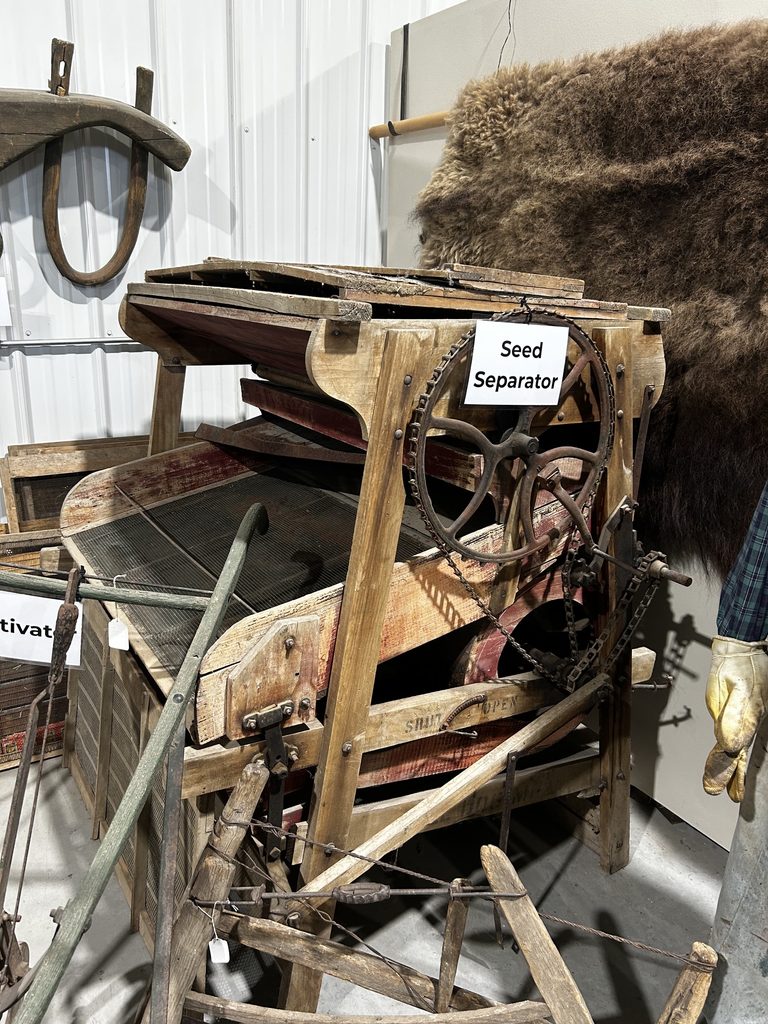
Seed Separator
This machine was used to clean and sort harvested grain and seed by combining shaking screens with a blast of air. Farmers turned the hand crank to separate valuable seed from chaff, dirt, and weed seeds, helping prepare crops for storage or planting.
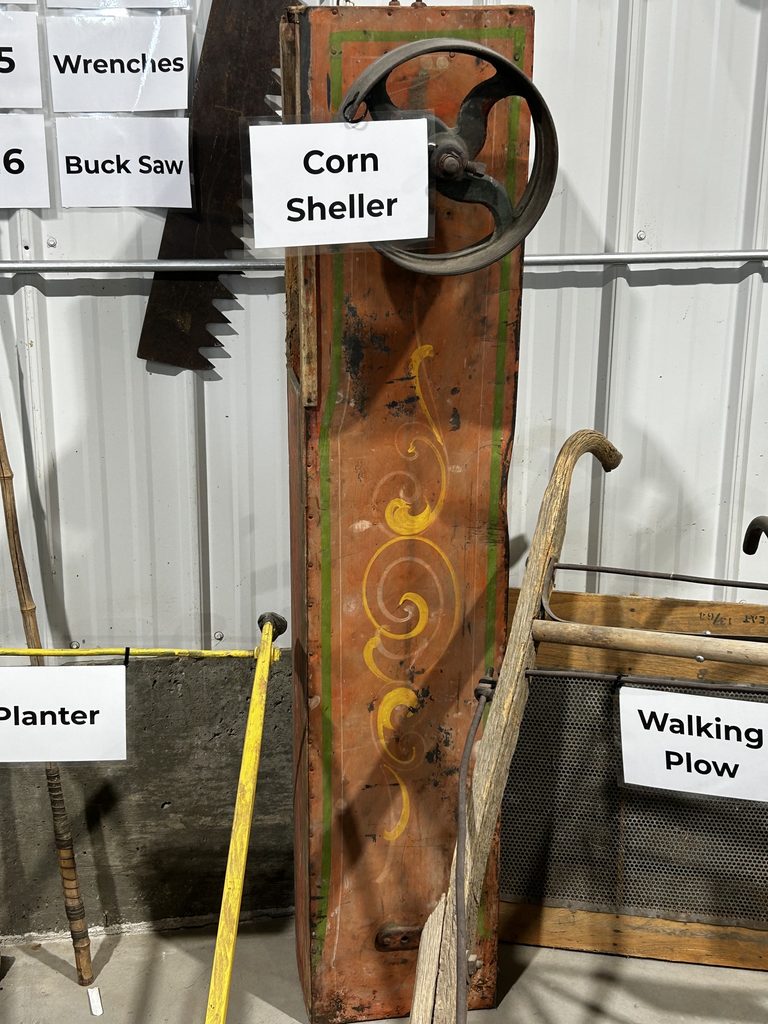
Hand-Crank Corn Sheller
Used in the late 1800s and early 1900s to remove kernels from dried ears of corn. The hand crank turned a toothed wheel that stripped the kernels from the cob, allowing the grain to be collected for livestock feed, seed, or milling.

Walking Plow, Potato Plow & Cultivator
Horse-drawn farm implements used primarily from the 1800s into the early 1900s
Walking Plow: Used to cut into and turn over soil, creating furrows for planting; these were especially common during the 1800s and early 1900s.
Potato Plow: Designed specifically for harvesting potatoes by digging beneath the plants and lifting the potatoes to the surface so they could be collected by hand.
Cultivator: Used after planting to loosen soil and remove weeds between rows of crops, helping crops grow without competing for water and nutrients. Horse-drawn cultivators were widely used from the mid-1800s into the early 20th century.
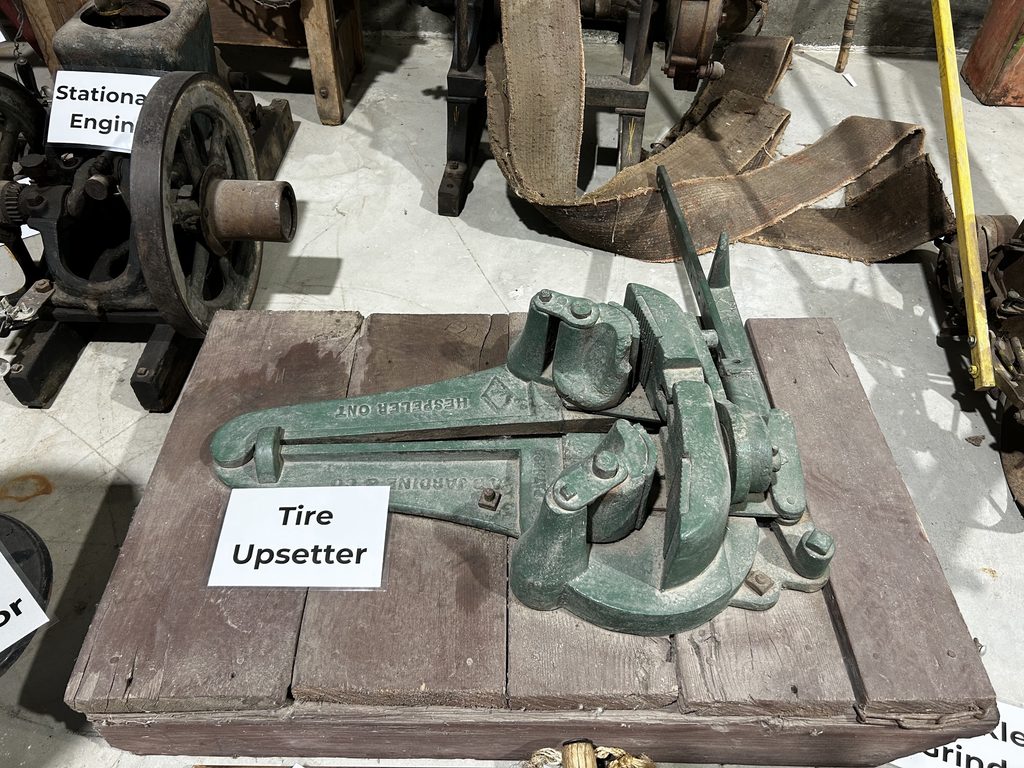
Tire Upsetter
A blacksmith’s tool used from the late 1800s into the early 1900s to shrink iron tires around wooden wagon and buggy wheels. Heated sections of the tire were clamped and compressed in the machine, making the tire smaller so it would fit tightly around the wheel.
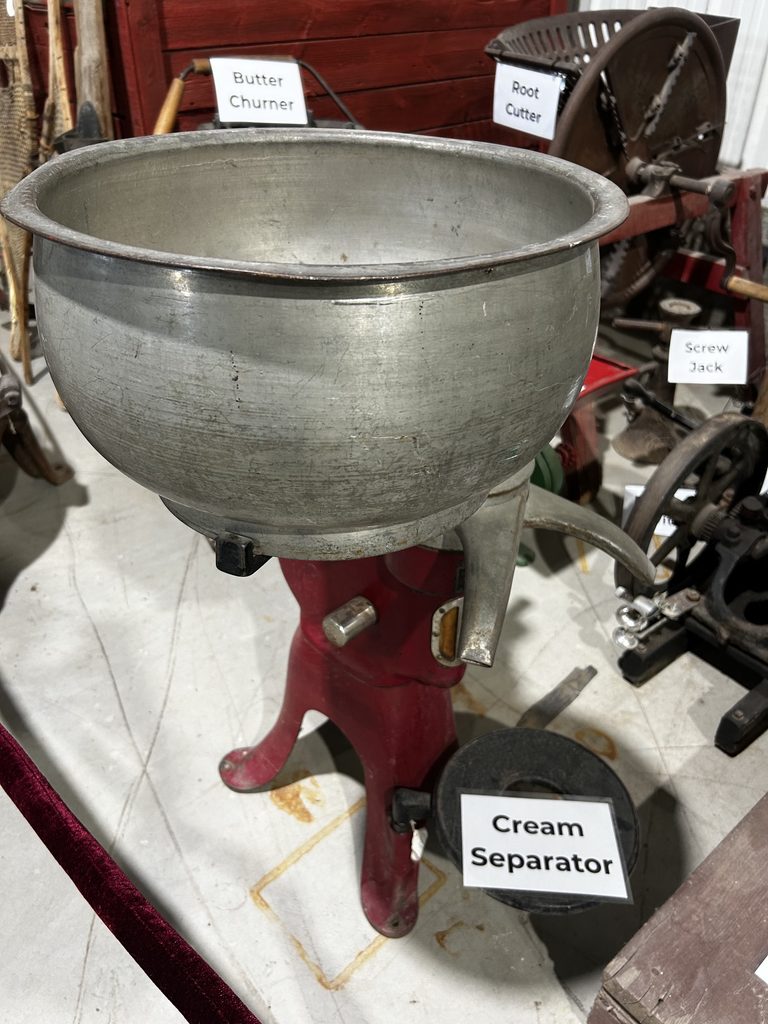
Renfrew Model K Cream Separator, Size 14 Cream Separator
This is an early 20th century cream separator. Fresh milk was poured into the bowl and separated into cream and skim milk by a hand-cranked spinning mechanism. Cream was used for butter or sold, while the skim milk was often fed to livestock. On this style of cream separator, the cream came out of the smaller, inner/higher spout, while the skim milk came out of the larger, outer/lower spout.
Barrel Butter Churn
Late 1800s–early 1900s. Cream was placed inside the wooden barrel and churned by turning the hand crank and operating the foot treadle, causing internal paddles to agitate the cream until butter separated from the buttermilk. This allowed farm families to make their own butter for household use or sale.

Recent Comments